An while ago, I was asked about if there was any benefit to ground the crystal case when using them in ladder filters. I provided an quite simplified analysis and a VNA picture. After some more thinking about it I decided to extend the analysis, as the simplified version does not cover it complete.
The crystal model we use is an simplification into known components that makes the analysis of the crystal possible with easy means:

An extension of this model is to extend the capacitor C0 into 3 capacitors.
The series resonance consisting of Lm, Cm and ESR can for frequencies outside the resonance range, be assumed to be high impedance and can be somewhat simplified to an voltage divider.

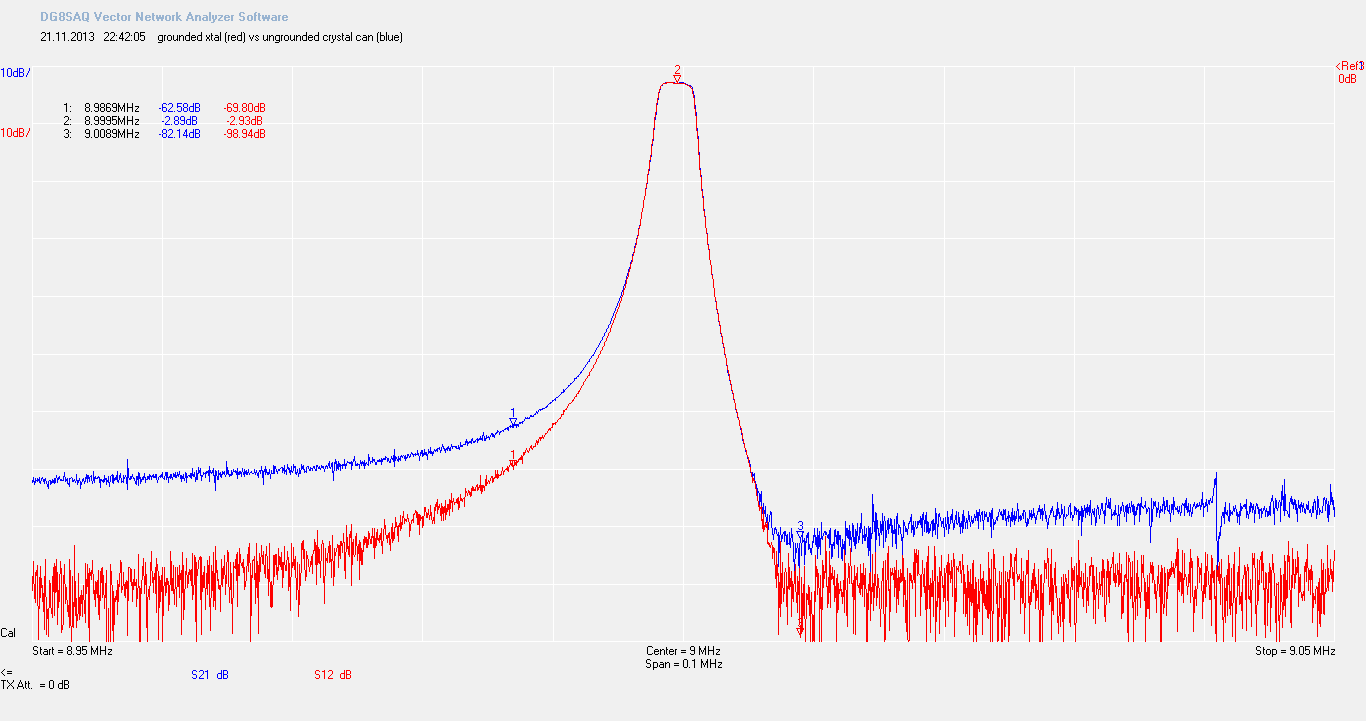
By grounding the case of the crystal, the capacitor C1 and C2 gets added to the shunt capacitors for the filter, while when the case is ungrounded the series connection of the capacitors add to the capacitor C0, leading to more of the signal leaking through at the stop-band.
A sweep from an VNA of a filter ungrounded (blue) and grounded (red) show how the stop-band attenuation changes
By taking a couple of measurements off several common HC49 528MHz crystals, I obtained the following results: C0=3.4pF, C1 = 2pF, C2=2.1pF.
This data correspond quite well to the rule used by several experimenter of C0=220Cm+1pF. The 220Cm part is due to the physics of the AT cut crystal. An different crystal will have different constants due to the physics of the crystal. The 1pF will be the result of the series connected capacitors C1 and C2.
As this simple analysis show, there is a benefit to ground the crystals. Most modern crystals are welded, and you will need quite a lot of heat to do damage to the crystal, while older crystals may be soldered. The stability of the crystal will be depending on the atmosphere inside the crystal. Some crystals change their parameters quite a lot when opened, while others don’t change at all, so avoid soldering directly to the old style crystals.
 RF and electronics blog LA3PNA